
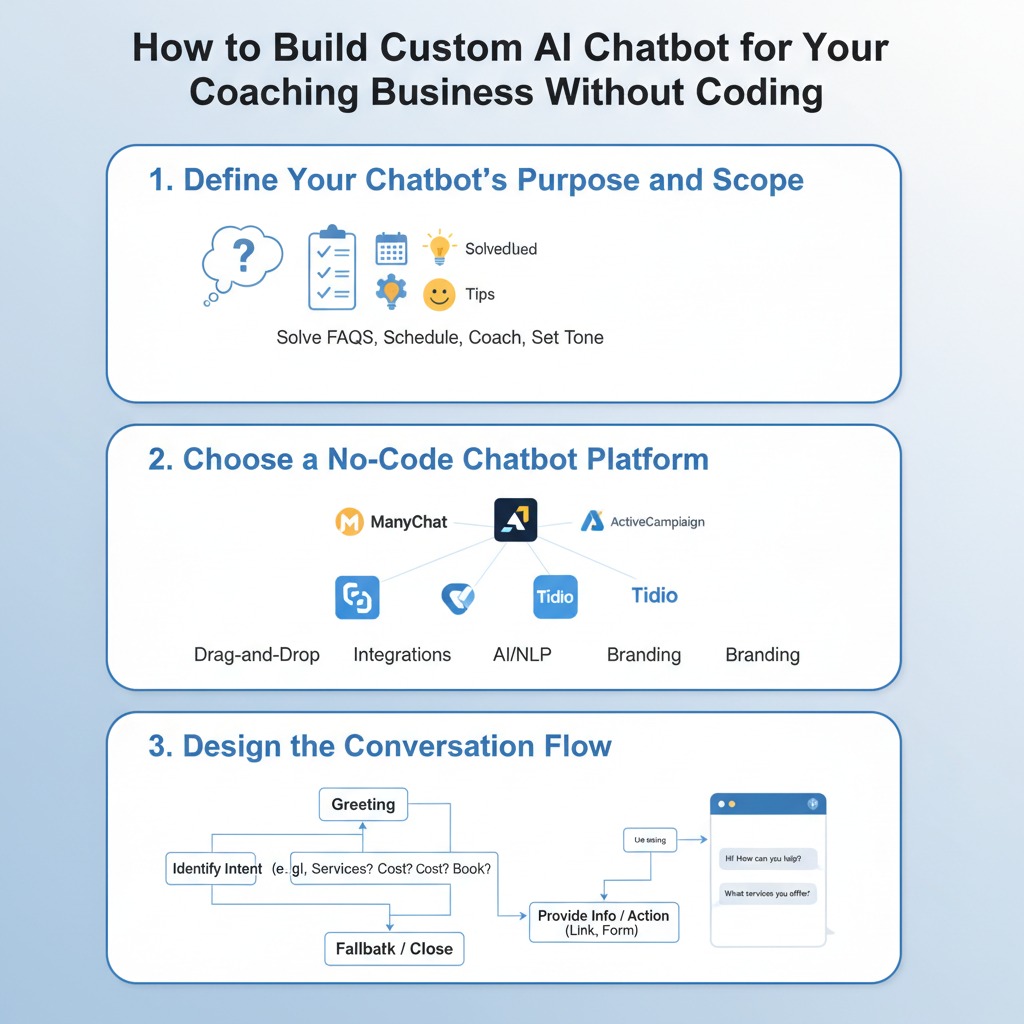
Building an AI chatbot for your coaching business sounds complicated, but it’s actually easier than setting up your first email campaign. If you can drag and drop, you can create a chatbot that handles client questions, books appointments, and qualifies leads while you sleep. No programming degree required.
I’ve spent years helping entrepreneurs automate their businesses, and AI chatbots have become one of the most powerful tools for coaches who want to scale without burning out. Whether you’re managing ADHD coaching clients, running a sobriety program, or coaching digital nomads across multiple time zones, a custom AI chatbot can handle the repetitive stuff so you can focus on what actually matters: transforming lives.
This guide walks you through everything you need to know about building your own AI chatbot without writing a single line of code. You’ll learn which platforms work best, how to train your bot to sound like you, and how to avoid the common mistakes that make chatbots feel robotic and unhelpful.
Why Every Coach Needs an AI Chatbot in 2026
The coaching industry has changed dramatically over the past few years. Clients expect instant responses, 24/7 availability, and personalized attention. But you’re human. You need sleep, personal time, and space to actually coach instead of answering the same questions over and over.
An AI chatbot for coaching business operations transforms how you communicate with clients. Instead of spending two hours every morning responding to emails asking about your pricing, availability, or program details, your chatbot handles these conversations automatically. This frees up your time for the high-value work that actually grows your business: strategy sessions, content creation, and building relationships.
For solopreneurs managing multiple income streams, automation becomes essential. You can’t scale a coaching business if you’re drowning in administrative tasks. A custom AI chatbot without coding handles client intake, answers frequently asked questions, and nurtures leads through your sales funnel. This means you can serve more clients without working more hours.
The impact on client satisfaction is real. When someone visits your website at 2 AM with an urgent question, your chatbot provides immediate support. When a potential client wants to know if your ADHD coaching program is right for them, your bot can qualify them before they ever book a discovery call. This creates a better experience for everyone involved and makes your business more scalable without sacrificing quality.
What Can an AI Chatbot Actually Do for Your Coaching Business?
AI coaching assistants handle way more than basic FAQs. A well-built chatbot becomes your first point of contact, your intake coordinator, and your follow-up system all rolled into one.
Automated client intake and qualification saves you hours every week. Your chatbot asks the right questions to determine if someone is a good fit for your program before they ever get on a call with you. This means you spend less time on discovery calls with people who aren’t ready to commit and more time with serious prospects who match your ideal client profile.
The 24/7 availability factor matters more than you might think. Your chatbot doesn’t take vacations, doesn’t need coffee breaks, and works across every time zone. If you’re coaching international clients or living the digital nomad lifestyle, this becomes incredibly valuable. Someone in New York can get answers at midnight while you’re exploring Bangkok.
Lead nurturing and follow-up sequences keep potential clients engaged without manual effort. Your chatbot can send helpful resources, check in with prospects who haven’t booked yet, and move people through your sales funnel automatically. This consistent follow-up turns more visitors into paying clients.
Booking and scheduling assistance eliminates the back-and-forth of finding meeting times. Your chatbot connects to your calendar, shows available slots, and books appointments directly. No more email chains trying to coordinate schedules across time zones.
Personalized content recommendations based on client needs make your chatbot feel genuinely helpful rather than just automated. If someone mentions they’re struggling with focus, your bot can share your best ADHD management resources. If they’re interested in building passive income, it can point them to your AI workflow automation strategies content.
Choosing the Right No-Code AI Chatbot Platform
Picking the right platform makes the difference between a chatbot that actually works and one that sits unused because it’s too complicated to maintain. You need something powerful enough to handle real conversations but simple enough that you can set it up in an afternoon.
Chatbase stands out for coaches who want to train their bot on existing content. You can upload your blog posts, coaching materials, and FAQs, and the AI learns your style and expertise. Pricing starts around $19 per month for basic plans, scaling up as you need more conversations and features. The interface is clean and requires zero technical knowledge.
Voiceflow offers more advanced conversation design if you want detailed control over how your chatbot flows. You can build complex decision trees, create multiple conversation paths, and design sophisticated qualifying sequences. The learning curve is slightly steeper, but the visual builder makes it manageable even for beginners. Plans start at $40 per month.
ManyChat works best if you’re focused on Facebook Messenger or Instagram DM automation. If your coaching business relies heavily on social media for client acquisition, ManyChat integrates seamlessly with these platforms. The free plan covers basic needs, while paid plans start at $15 per month.
Zapier AI connects your chatbot to thousands of other tools without coding. You can trigger actions in your CRM, send emails, update spreadsheets, and automate your entire coaching business workflow. This matters if you’re already using multiple tools and want everything to work together smoothly.
Evaluating which platform matches your coaching niche depends on your specific needs. If you run ADHD coaching or sobriety coaching programs, you need a platform that can handle sensitive conversations with empathy and intelligence. Test the natural language processing capabilities before committing. Some platforms sound robotic while others can carry genuine conversations.
For digital nomads working across time zones, integration capabilities matter more than anything else. Make sure your chosen platform connects to your calendar, email system, and payment processor. You don’t want to manually sync data between systems while traveling.
Step-by-Step Guide to Building Your First AI Chatbot
Building your chatbot follows a clear process. Skip steps and you end up with something that confuses clients instead of helping them. Follow this sequence and you’ll have a functional AI chatbot for coaching business operations running within a week.
Define Your Chatbot’s Purpose and Personality
Start by identifying your coaching business goals. Do you want to automate discovery call bookings? Qualify leads before they talk to you? Provide 24/7 support for existing clients? Your chatbot needs a clear job description just like a human team member.
Map out common client questions and pain points before you start building. Look through your email inbox, review your DMs, and list every question you answer repeatedly. These become the foundation of your chatbot’s knowledge base. If you get asked about pricing ten times a week, that’s priority content for your bot.
Create a brand-aligned conversational tone that matches how you actually talk to clients. If you’re casual and direct in your coaching sessions, your chatbot should be too. If you take a more structured approach, reflect that in the bot’s language. The goal is making conversations feel natural, not like talking to a customer service robot.
Your chatbot personality should reflect the mindset shift that takes you from hustler to global entrepreneur. This means being supportive but direct, encouraging but honest, and always focused on helping clients take action rather than just providing information.
Gather and Organize Your Knowledge Base
Collect every piece of content that explains your coaching approach, methodologies, and answers to common questions. This includes your website copy, blog posts, coaching materials, client testimonials, and any documentation you’ve created over the years.
Structure information for AI comprehension by breaking complex topics into clear, simple explanations. AI chatbots understand straightforward language better than fancy jargon. If you wouldn’t say it in a conversation with a client, don’t include it in your knowledge base.
Use existing content to train your chatbot instead of creating everything from scratch. Your blog posts, email newsletters, and social media content already contain your expertise. Most no-code platforms let you upload documents or paste URLs to automatically extract information.
If you’re just getting started with automation, check out the free AI automations course for founders to understand how AI systems process and organize information. This foundation helps you structure your knowledge base more effectively.
Build Your Chatbot Flow Without Writing Code
Open your chosen platform and start with the visual chatbot builder. Most no-code tools use a drag-and-drop interface where you create conversation blocks and connect them with arrows. Think of it like mapping out a conversation on a whiteboard.
Create conversation paths and decision trees by asking yourself what happens next after each response. If someone says they’re interested in your coaching program, what question should the bot ask next? If they say they’re just browsing, how should the bot respond to keep them engaged?
Set up trigger words and intent recognition so your chatbot understands variations of the same question. Someone might ask “How much do you charge?” or “What’s your pricing?” or “Can you tell me about costs?” Your chatbot should recognize these as the same intent and provide the same answer.
Add fallback responses for unclear queries because your bot won’t understand everything. When someone asks something outside your chatbot’s knowledge, it should gracefully admit it doesn’t know and offer to connect them with you directly. This honesty builds trust more than trying to fake understanding.
Train Your AI with Your Coaching Expertise
Upload documents, website content, and resources into your chatbot platform. Most systems analyze this content and automatically generate responses based on the information. The more quality content you provide, the smarter your chatbot becomes.
Fine-tune responses to reflect your coaching methodology by reviewing the suggested answers and adjusting them to match your voice. The AI gives you a starting point, but you need to refine it so it sounds like you, not like generic business copy.
Test conversational accuracy by having real conversations with your chatbot. Ask it the questions your clients actually ask and see how it responds. If the answers feel off, adjust the training data or rewrite specific responses until they’re accurate and helpful.
Ensure responses align with your ADHD management or sobriety coaching approach by reviewing every answer through the lens of your specific niche. If you work with clients struggling with focus, your chatbot should offer understanding and practical solutions, not generic productivity advice. If you coach people in recovery, every response needs to be supportive and trauma-informed.
Integrate Your Chatbot with Existing Tools
Connect your chatbot to your CRM, email marketing platform, and calendar so everything works together automatically. When someone books a discovery call through your chatbot, that information should flow directly into your scheduling system and CRM without manual data entry.
If you serve clients through messaging apps, consider automating your coaching business with an AI WhatsApp bot to meet them where they already communicate. This integration creates a seamless experience and reduces friction in your client acquisition process.
Set up payment processing for coaching packages directly through your chatbot when possible. Some platforms integrate with Stripe, PayPal, or other payment processors, letting clients purchase your services without leaving the conversation. This reduces drop-off and increases conversion rates.
Sync with Zoom or other video conferencing platforms so your chatbot can automatically generate and send meeting links when booking appointments. The less manual work required, the more time you save and the smoother the client experience becomes.
Customizing Your AI Chatbot for Different Coaching Scenarios
A single chatbot flow doesn’t work for every situation. You need different conversation paths for discovery calls, program inquiries, and ongoing client support. Create separate flows that address specific needs without overwhelming people with irrelevant information.
Build personalized pathways for ADHD coaching versus sobriety coaching clients because these audiences have different concerns and communication styles. Someone exploring ADHD coaching might need information about focus strategies and executive function support. Someone interested in sobriety coaching needs to know your approach is compassionate, confidential, and rooted in real recovery experience.
Set up automated qualifying questions to filter serious leads from casual browsers. Ask about their current challenges, their timeline for making a change, and their commitment level. This information helps you prioritize follow-up and ensures you’re spending time with people ready to invest in themselves.
Design compassionate, supportive responses for vulnerable client moments. If someone mentions they’re struggling or feeling overwhelmed, your chatbot should acknowledge that difficulty and offer immediate support resources. This human touch matters even in automated conversations and reflects the empathy that makes your coaching effective.
Common Mistakes to Avoid When Building Your AI Chatbot
Over-complicating the conversation flow kills chatbot effectiveness. Beginners often create elaborate decision trees with dozens of branches, thinking more options equals better service. In reality, simpler flows work better. Focus on the core questions clients actually ask rather than trying to cover every possible scenario.
Neglecting to update your knowledge base regularly leads to outdated information and frustrated clients. Your coaching approach evolves, your pricing changes, and your programs get updated. Set a monthly reminder to review and refresh your chatbot’s content so it always reflects current reality.
Making the chatbot too robotic or impersonal destroys trust before it builds. Yes, clients know they’re talking to a bot, but that doesn’t mean the conversation needs to feel cold. Use contractions, show empathy, and write like you’re talking to a friend who needs help.
Falling into the execution over ideation trap by endlessly tweaking your chatbot instead of launching it. Your first version won’t be perfect, and that’s fine. Get it working, put it live, and improve based on real feedback. Waiting for perfection means never launching.
Forgetting to test across different devices and platforms creates broken experiences. What looks great on desktop might be unreadable on mobile. What works smoothly in Chrome might glitch in Safari. Test your chatbot everywhere your clients might use it before announcing it to your audience.
How to Optimize Your Chatbot for Lead Generation and Client Conversion
Craft compelling opening messages that engage visitors immediately. Instead of “Hi, how can I help you?” try something specific like “I help entrepreneurs break free from the hustle and build businesses that support their lives. What’s your biggest challenge right now?” Specific, relevant opening messages get more responses.
Strategic question sequencing qualifies prospects without feeling like an interrogation. Start with their biggest pain point, then ask about their timeline, then explore their commitment level. This natural progression builds rapport while gathering the information you need to decide if someone is a good fit.
Use urgency and scarcity ethically to encourage action. If you only have three coaching spots available this quarter, your chatbot can mention that. If you’re running a limited-time offer, share the deadline. But never fabricate scarcity or use manipulative tactics. Your reputation matters more than any individual sale.
Collect contact information without being pushy by offering value in exchange. “Want me to send you my free guide on managing ADHD as an entrepreneur? Drop your email and I’ll get it to you in the next 60 seconds.” This approach builds your list while providing immediate value.
If you’re building an accountability-focused practice, reference why every successful entrepreneur needs an accountability coach in your chatbot conversations. This positions your services as essential rather than optional.
Measuring Your AI Chatbot’s Performance and ROI
Track response rate to see what percentage of visitors actually engage with your chatbot. If only 5% of people interact, your opening message might not be compelling enough. If 40% engage, you’re doing something right. Industry benchmarks suggest 20-30% is solid for coaching websites.
Monitor conversion rate from chatbot conversation to desired action. This might be booking a discovery call, joining your email list, or purchasing a program. Calculate how many people complete your desired action divided by total conversations. Track this monthly to spot trends and improvements.
Measure engagement time to understand if people are having real conversations or bouncing quickly. If average engagement time is under 30 seconds, your chatbot probably isn’t providing value. If people spend 3-5 minutes interacting, you’re delivering helpful information that keeps them engaged.
Use analytics to identify conversation bottlenecks where people drop off. Maybe everyone exits after you mention pricing, which suggests you need to build more value before discussing cost. Maybe people abandon the conversation when asked for their phone number, indicating that’s too much commitment too early.
A/B test different messaging approaches by running two versions of key conversation elements. Test different opening messages, various qualifying questions, and alternative ways of presenting your offers. Let data guide your optimization rather than guessing what might work better.
Calculate time saved and revenue generated to determine real ROI. If your chatbot handles 100 conversations per month that would have taken you 30 minutes each, that’s 50 hours saved. If it converts even 5 of those into paying clients, the revenue impact probably covers your entire automation stack.
Advanced AI Chatbot Features for Growing Coaching Businesses
Multilingual support expands your market if you coach global digital nomad clients. Some platforms offer automatic translation that lets your chatbot communicate in Spanish, German, French, or dozens of other languages without you creating separate versions.
Voice integration improves accessibility and creates a more natural experience for some users. People can speak their questions instead of typing them, which matters for clients with learning differences or those who prefer verbal communication.
AI-powered sentiment analysis detects when clients feel frustrated or enthusiastic during conversations. If someone’s responses suggest anger or disappointment, your chatbot can adjust its approach or immediately offer to connect them with you personally. If they’re excited and engaged, it can move them toward a purchase more confidently.
For coaches managing time zones while coaching international clients from Asia to the US, advanced scheduling features become critical. Your chatbot should automatically detect a visitor’s time zone and present available appointments in their local time, preventing confusion and missed meetings.
Automated upselling and cross-selling of coaching packages happens naturally when your chatbot understands client needs. If someone books a single coaching session, your bot can mention your three-month intensive program. If they’re interested in ADHD coaching, it can introduce your productivity course. This passive revenue generation happens without pushy sales tactics.
Maintaining and Improving Your Chatbot Over Time
Schedule regular content updates based on new coaching insights you develop. When you create a new framework or methodology, add it to your chatbot’s knowledge base. When you write a new blog post answering common questions, feed that content into your bot.
Incorporate client feedback into conversation design by asking people about their chatbot experience. Send a quick survey after interactions asking what was helpful and what could be better. Real user feedback beats assumptions every time.
Make seasonal adjustments for business cycles in the coaching industry. If you run a January enrollment period, update your chatbot to reflect those dates and create urgency. If summer is slow, adjust messaging to focus on getting ahead before fall.
Scale your chatbot as your coaching business grows by adding new conversation paths for new services. When you launch a group coaching program, create a dedicated flow for it. When you start offering corporate training, build separate qualifying questions for business clients versus individual coaching clients.
Learn about integrating AI tools to save 10 hours a week in your online business to understand how your chatbot fits into a broader automation strategy. The most successful coaches use multiple AI tools that work together seamlessly.
Real Success Stories: Coaches Who Transformed Their Business with AI Chatbots
One ADHD coach implemented a simple chatbot that qualified leads before discovery calls. Within three months, she cut her discovery call time by 60% while doubling her conversion rate. The chatbot filtered out people who weren’t ready to commit and pre-qualified serious prospects, meaning every call she took had a higher chance of converting.
A sobriety coach struggling to manage client inquiries across different time zones added a chatbot that provided immediate resources and crisis support information. Client satisfaction scores increased by 40% because people got instant help instead of waiting hours for email responses. The coach reported feeling less anxious about missing urgent messages.
An entrepreneurship coach running three different online brands used chatbots to handle routine questions across all properties. This freed up 15 hours per week previously spent on repetitive administrative work. He redirected that time into creating content and building strategic partnerships, which grew his revenue by 85% over six months.
These coaches all faced the challenge of overcoming burnout when you run multiple online brands. AI chatbots gave them breathing room to focus on high-impact work rather than drowning in messages and intake forms.
Multiple coaches report that automated client acquisition through chatbots feels more authentic than traditional sales funnels. Clients appreciate getting immediate answers and personalized attention, even knowing they’re interacting with AI. The key is maintaining your voice and values throughout the automated experience.
FAQ
How much does it cost to build a custom AI chatbot for my coaching business?
Basic no-code chatbot platforms start around $15-20 per month for entry-level plans. As you need more conversations, integrations, and advanced features, costs typically range from $40-100 monthly. Most coaches find the time saved and leads generated make this investment worthwhile within the first month.
Do I need technical skills or coding knowledge to create an AI chatbot?
No technical skills required. Modern no-code chatbot builders use visual interfaces where you drag and drop conversation elements. If you can use basic software like email or social media, you can build a chatbot. Most platforms also offer templates specifically designed for coaching businesses that you can customize.
Can my AI chatbot handle sensitive topics like ADHD or sobriety coaching?
Yes, but you need to program it carefully with appropriate responses. Include compassionate language, clear boundaries about what the bot can and cannot do, and easy ways to connect with you directly for serious concerns. Never let your chatbot try to provide actual coaching or crisis intervention. It should acknowledge concerns and facilitate human connection.
How long does it take to build and launch a functional AI chatbot?
A basic chatbot handling common questions and booking appointments can be built in 4-8 hours spread over a few days. A more sophisticated bot with multiple conversation paths, knowledge base training, and integration with other tools might take 2-3 weeks of part-time work. You can start simple and expand functionality over time.
Will an AI chatbot replace the human connection in my coaching practice?
Not at all. Your chatbot handles repetitive administrative tasks so you have more time for actual coaching relationships. It’s your intake coordinator and assistant, not your replacement. Clients still work with you for transformation and growth. The bot just makes that relationship more accessible and efficient.
Can I use the same chatbot for multiple coaching niches or businesses?
Yes, though you’ll want to create separate conversation flows for different audiences. Most platforms let you build multiple bots or create branching logic that customizes responses based on which niche someone is interested in. This works well if you offer both ADHD coaching and entrepreneurship coaching, for example.
How do I ensure my AI chatbot respects client privacy and data security?
Choose platforms with strong security certifications and clear privacy policies. Never store sensitive information in your chatbot unless it’s properly encrypted. Be transparent with clients about what data you collect and how you use it. Most reputable platforms comply with GDPR and other privacy regulations automatically.
What happens when my chatbot doesn’t understand a client’s question?
Program a fallback response that gracefully admits the limitation and offers alternatives. Something like “I’m not sure I understand that question. Would you like to schedule a call with me directly, or can you rephrase so I can try to help?” This honesty builds trust and ensures clients always have a path forward.
Taking Action on Your AI Chatbot
Building a custom AI chatbot for your coaching business without coding is one of the smartest investments you can make in 2026. It saves time, qualifies leads, and provides better client experiences without requiring technical expertise or huge budgets.
Start with a clear purpose. Don’t try to build the perfect chatbot that does everything. Pick one specific goal like automating discovery call bookings or answering common program questions. Build that, test it, and expand from there.
The coaching industry is moving toward automation not because we want to remove the human element, but because we want to protect it. By automating repetitive tasks, you create more space for the deep, transformative work that actually changes lives. Your chatbot becomes the tool that lets you scale your impact without scaling your stress.
Remember that your chatbot represents you and your brand. Make it sound like you, fill it with your expertise, and use it to serve clients better. When done right, an AI chatbot for coaching business operations becomes one of your most valuable team members, working around the clock to grow your practice while you sleep, travel, or focus on what you do best: coaching people toward their breakthroughs.
Leave a Reply